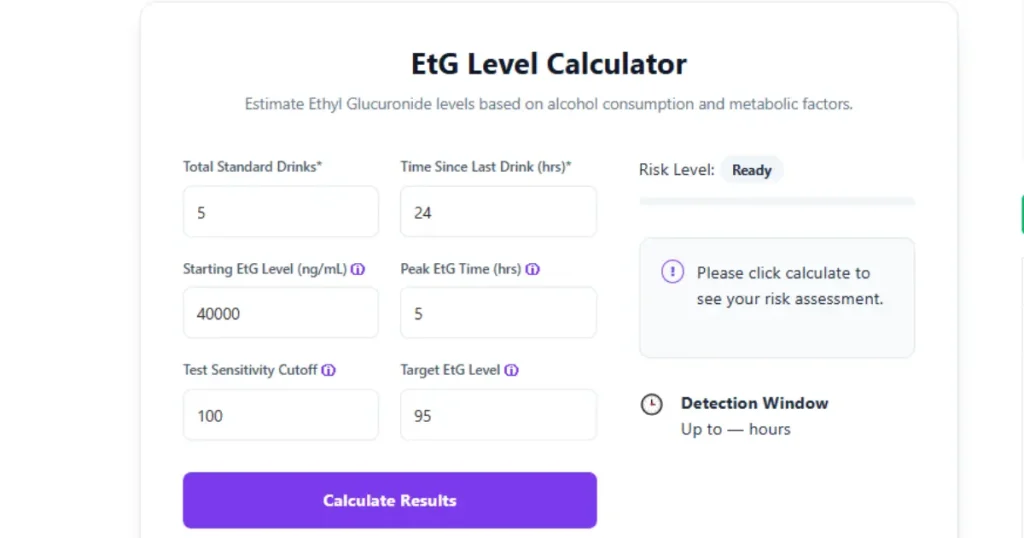
EtG Level Calculator
Estimate Ethyl Glucuronide levels based on alcohol consumption and metabolic factors.
Up to — hours
Introduction
The question most people ask themselves is; how long does alcohol remain in your system? An increasing number of individuals seek to know how to determine alcohol metabolism particularly when they are being tested in the workplace, during a medical check-up or even when they are monitoring themselves. ETG Calculator may be useful at this point.
And with a mere comprehension of it. ETG is the abbreviated form of Ethyl Glucuronide, which is a substance that your body produces once you drink alcohol. ETG can be used longer than alcohol itself and you can find it used in tests to determine if you have recently used alcohol. Therefore, rather than directly measuring the presence of alcohol, ETG testing identifies this byproduct.
This may leave you wondering why this is important. Well, ETG tests are regularly utilized in workplace and recovery programs, or under legal circumstances where alcohol intake must be observed over a period. ETG offer a broader limiting time compared to alcohol, as it can remain longer in the body.
An ETG Calculator assists in estimating the time that ETG may be present under certain conditions such as the quantity of alcohol used, metabolism in the body and time. No need to worry, it is easy to operate and does not need a medical expert. It provides you with an approximate time but not a definite answer.
Imagine an alcohol guide that you use to learn how alcohol is processed in your body with time. It is not an ideal science but it provides a handy point of reference when planning and being aware.
This article will take us through what the tool is and how it functions as well as how you can apply the tool in a practical and simple manner.
What is ETG Calculator
An ETG Calculator is a web based calculator estimating the duration of Ethyl Glucuronide (ETG) in the body following alcohol intake. ETG is a metabolite formed when the liver metabolizes the alcohol, which can be identified in urine tests and last a longer time than alcohol.
This is mostly used as a reference to get to know about detection windows. Take alcohol, which in the blood may be detected within the hours, ETG could be detected over a number of days depending on a number of factors.
The inputs for the ETG Calculator include the quantity of alcohol being taken, duration since the intake, weight, and occasionally metabolic rate. It uses these inputs to estimate the possibility of the remaining of ETG at detectable levels.
You may consider it as a foretelling instrument. It does not bring any medical diagnosis or assured results, but it allows the users to determine the potential results. It comes in particularly handy when someone has to learn the schedule of testing, or get ready their expectations prior to an ETG test.
Simply, the calculator is used to answer one important question: How long can ETG remain in my system after drinking? Although outcomes may differ depending on an individual, the tool gives one a rough estimate based on popular data and assumptions.
How It Works
The ETG Calculator is a tool that takes a small amount of basic inputs and uses familiar alcohol metabolism trends.
First, you will provide information on the amount of alcohol you drank, the period it has taken since you last drank, and in some cases, individual consideration such as body weight. These data points assist the calculator to approximate how your body will process alcohol.
The tool then uses average metabolic rates and scientific assumptions about the formation and elimination of ETG. Because all individuals have their own bodies, the calculator is only approximate with reference to biological measurements.
It then estimates a window of detection. This window shows how far ETG may still be present in your system given the inputs to it.
The result is typically given in a straightforward form, as a time range or a potentially detectable vs. potentially undetectable outcome. This simplifies its comprehension to the uninformed.
Simply stated, the ETG Calculator takes your input, along with general metabolic data to provide you with a realistic estimate of ETG presence over time.
Benefits of ETG Calculator
There are some handy benefits to an ETG Calculator:
- Helps approximates alcohol DET time in a rudimentary manner.
- Gives information on window of ETG testing.
- helpful in pre-medical or pre-working testing.
- Simple to operate and no technical skill is needed.
- Time saving over manual research.
- Provides expediency estimates using regular data.
- Helps enhance the knowledge of the body processes that alcohol goes through.
- Should be able to support individual consciousness and responsible planning.
These advantages render the tool useful to any individual who wishes to have a rough idea of the detection timelines of ETG.
How to Use the Tool.
Application of an ETG Calculator is very easy. Here’s how you can use it:
- Install the ETG Calculator tool on your computer.
- Enter how much alcohol you have consumed.
- Enter since consumed time.
- Include any extra details such as weight of the body (optional).
- Click either the calculate or submit button.
- Look at the predicted ETG detection window.
That’s all it takes. Within a few seconds, the tool will calculate the results and the results will be displayed. It is meant to be easy-going and user-friendly.
Real-Life Example
To illustrate, consider a situation where one had a couple of drinks during an evening event and would like to know how long ETG will stay in their system. They fill the ETG Calculator with information such as the body weight, number of drinks and time since the last drink.
The calculator approximates that the ETG can be detected over some number of hours or days depending on the inputs. This assists the individual to have a rough picture of whether ETG may be present when that individual takes a subsequent test.
Such an estimate may be useful in regard to awareness. The user can gain greater insight into timing and make more informed decisions, rather than just guessing.
Pro Tips for Best Results
- Be better estimators by entering correct and truthful information.
- Keep in mind the results are approximate not accurate.
- Never use the calculator to make important decisions.
- Take into account such personal factors as metabolism and hydration.
- The tool is not a guarantee, use it as a guide.
- Add to it some general information on alcohol metabolism.
The following tips will aid you in better interpreting the results of the ETG Calculator.
Conclusion
In estimating the possible duration of Ethyl Glucuronide in the body following alcohol use, an ETG Calculator is a handy and easy to use tool. It gives the general idea on that detection windows depend on such inputs as consumption amount, time etc.
Although it does not substitute professional testing or medical consultation, it can provide you with valuable information on how your body handles alcohol throughout a period of time. Being easy to fill in and providing quick outputs, it is a convenient resource that a person may consult to know the timelines of ETG in a straightforward and simple manner.
Frequently Asked Questions (FAQ) – ETG Calculator
Q1: How long does ETG stay detectable?
A: ETG can be detected in urine for up to 80 hours after alcohol consumption, depending on the amount consumed and individual metabolism.
Q2: Is the ETG Calculator 100% accurate?
A: While highly reliable, it provides estimates. Individual metabolic differences may cause slight variations.
Q3: Can this replace lab testing?
A: No, the calculator is for informational purposes only. Official results require laboratory testing.
Q4: Can ETG levels be affected by alcohol-free products?
A: Yes, some products containing alcohol (like mouthwash or hand sanitizer) can slightly increase ETG levels, though usually below test thresholds.
Q5: Is it safe to use for personal tracking?
A: Absolutely! It’s a helpful tool for monitoring alcohol consumption patterns and staying within safe limits.